Christmas in the Midwest: German Markets, Lakefront Wind and Small-Town Bavaria
The Midwest takes its Christmas customs from nineteenth-century German, Scandinavian and Polish immigrants, and its weather from Canada. Dress for both and it is one of the best-value holiday regions in the country.
Why the Midwest is underrated in December
Ask an American to name a Christmas destination and the Midwest rarely comes up first. That is the region's advantage. Hotel rates in Chicago in December are often well below summer levels, small towns are not overrun, and the customs on show are rooted in real immigrant communities rather than invented for visitors. Christmas markets, Advent wreaths and Christmas Eve services in German or Swedish still have living roots here.
The cost is cold. December highs across much of the region sit around or below freezing, and lake-effect snow can drop heavy, localised bands of snow downwind of the Great Lakes, especially in Michigan and northern Indiana. Wind off Lake Michigan makes Chicago's lakefront feel far colder than the thermometer says. None of this stops locals from going out; it just means insulated boots, a proper hat and plans that can shift by a day.
Six stops from Lake Michigan to the Missouri River
- 01
Chicago
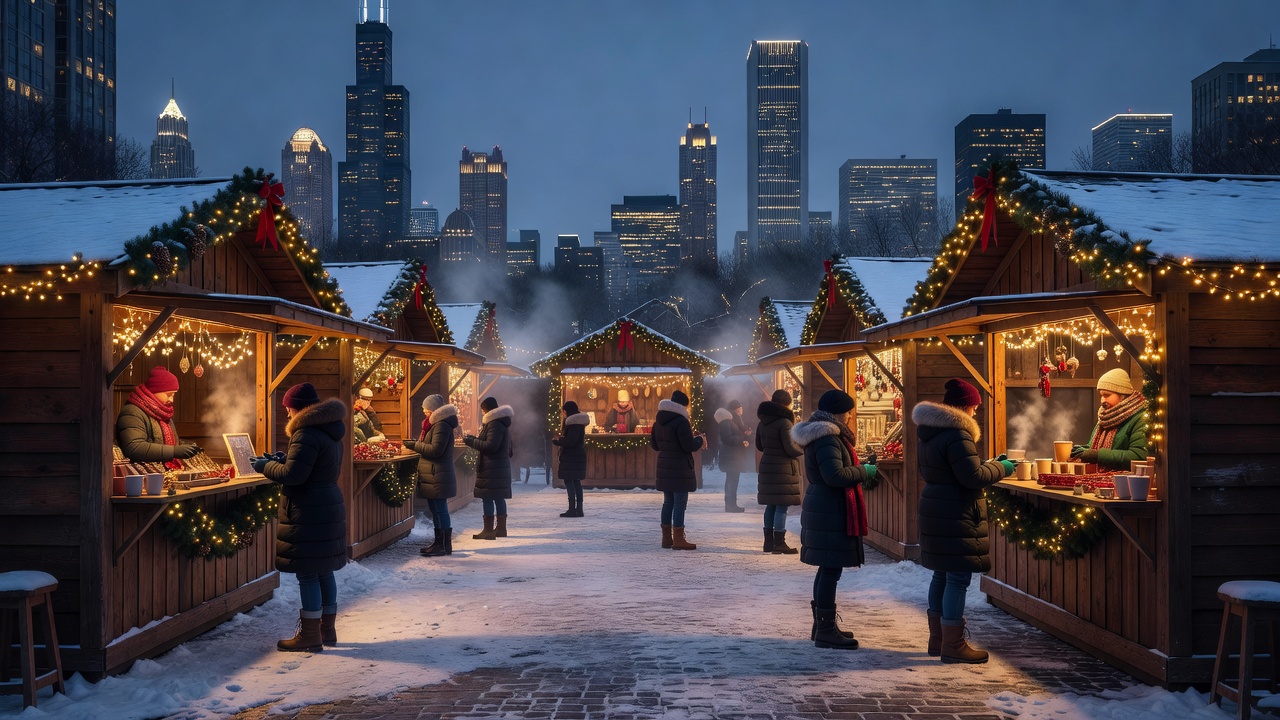
The Christkindlmarket opened in Daley Plaza in 1996, modelled on the long-established market in Nuremberg, and it remains the city's main Christmas gathering point, with mulled wine served in collectible mugs whose design changes each season. A second market runs in Wrigleyville near the ballpark. The season opens earlier than in most cities: the Magnificent Mile Lights Festival usually takes place the weekend before Thanksgiving, with a parade along Michigan Avenue. Other fixtures include the tree in the Walnut Room of the former Marshall Field's store on State Street, ZooLights at Lincoln Park Zoo and skating in Millennium Park. Most of it is reachable on the "L" from either O'Hare or Midway.
- 02
Frankenmuth
Settled in 1845 by Lutheran missionaries from Franconia in Bavaria, Frankenmuth leaned into its heritage after the Second World War with Bavarian-style buildings, a covered bridge and restaurants known for family-style chicken dinners. Its biggest draw is Bronner's, an enormous year-round Christmas store with a replica of the Silent Night chapel from Oberndorf, Austria, on its grounds. It is undeniably commercial, but it is cheerful and very easy with children. Frankenmuth is about ninety minutes north of Detroit by car.
- 03
Galena
Galena's steep Main Street of red-brick nineteenth-century buildings survived largely intact because the town's lead-mining wealth faded before anyone could tear it down. That makes it a good small-town alternative to Chicago, about three hours west. Ulysses S. Grant lived here before the Civil War, and the house the town gave him afterwards is open as a state historic site. December brings candlelit evenings and decorated shopfronts; check the town's own events calendar for exact dates, as smaller programmes vary from year to year.
- 04
Indianapolis
Each year the Soldiers' and Sailors' Monument on Monument Circle is strung with lines of lights from its peak to the ground, turning a 284-foot Civil War memorial into a giant tree shape. The Circle of Lights ceremony, a tradition since the 1960s, usually happens the evening after Thanksgiving and draws a big local crowd. Indianapolis is compact, inexpensive and well placed for a road trip, and it works well as a one-night stop between Chicago and the Ohio River.
- 05
Kansas City
The Country Club Plaza, a shopping district built in the 1920s in a Spanish-inspired style, outlines its towers and rooflines in coloured lights, a custom dating to that decade. The lights are switched on at a ceremony on Thanksgiving night and stay up into January. Union Station, a restored 1914 railway terminal, adds its own holiday displays. Kansas City barbecue is not a Christmas tradition, but it is a strong reason to come anyway.
- 06
Saint Paul
The coldest stop on this page. Saint Paul's European-style Christmas market, held at the restored Union Depot, has quickly become a winter fixture, with wooden stalls under the station's great hall and outside on the plaza. The Landmark Center, a turreted former federal courthouse, hosts concerts and displays. Minnesota's Scandinavian heritage shows in Swedish and Norwegian holiday foods sold at church bazaars across the Twin Cities. December highs are often in the 20s °F, and nights below zero are possible.
Midwest stops at a glance
Rough long-term December averages. Cold snaps can push temperatures far lower for days at a time.
| Stop | Typical December high | Best timing | Getting there |
|---|---|---|---|
| Chicago, IL | Mid 30s °F | Weekday evenings at the market | O'Hare or Midway, Amtrak |
| Frankenmuth, MI | Low to mid 30s °F | Any December weekday | Car from Detroit |
| Galena, IL | Low 30s °F | Early December weekends | Car from Chicago |
| Indianapolis, IN | Around 40 °F | Night after Thanksgiving | Indianapolis airport, I-65 |
| Kansas City, MO | Low 40s °F | Thanksgiving night onward | Kansas City airport, Amtrak |
| Saint Paul, MN | 20s °F | Market weekends in December | Minneapolis–Saint Paul airport, light rail |
Practical notes for the Midwest
Flights through hubs
Chicago O'Hare and Minneapolis–Saint Paul are major hubs, which helps with fares but means snowstorms ripple across connections. Build a spare day into any tight Christmas schedule.
Dressing for wind
Layers beat one heavy coat. A windproof outer shell, a hat that covers the ears and waterproof boots matter more than anything fashionable, especially near Lake Michigan.
Market hours
German-style markets in the region generally close on or before Christmas Eve afternoon. Go earlier in the month if the market is the reason for your trip.
Car travel
Interstates are ploughed fast, but lake-effect bands can cut visibility suddenly on I-94 and I-196 in Michigan. Check state transportation department road reports before setting out.
For snow with mountains instead of lakes, read the West and Pacific guide. For older colonial traditions, return to the Northeast.